
Where to park the HVE between uses
October 1, 2026 · 3 min read
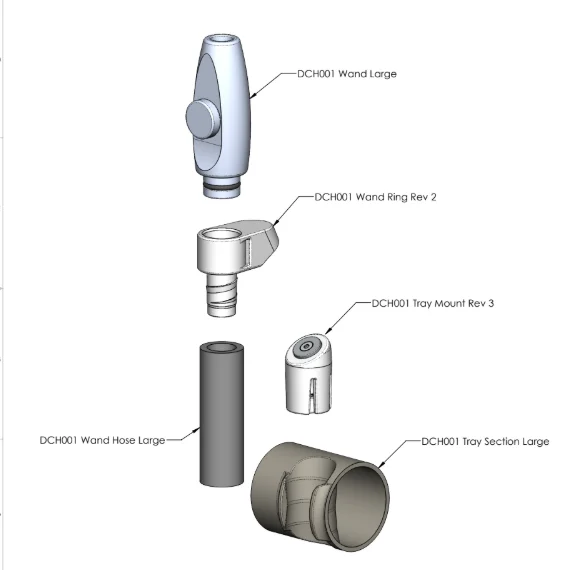
Ask five assistants where the HVE goes between uses and you’ll get five answers. Across the tray. Back in the factory holder. Tucked against the bracket. Hooked over the edge of the unit. Held, because setting it down means picking it up again.
None of those is wrong, exactly. They’re just different, and the difference is the problem.
The three places it usually ends up
The factory hanger holder. This is what the unit was designed around, and it works. The catch is the motion: you’re threading a tip back into a slot with one hand, often without looking, mid-procedure. It takes a second of attention every time, and under time pressure people stop doing it.
On the tray. Fast and silent, which is exactly why it’s so common. It also puts a contaminated tip on the same surface as the instruments, and a hose under tension will pull it off the edge sooner or later.
Nowhere in particular. Draped, wedged, or held. That’s the default once the schedule is running behind.
The pattern underneath all three is the same. The HVE has no position that is both fast to reach and reliable to return to, so the team optimizes for speed and accepts the occasional drop.
What a drop actually costs
More than the tip.
The tip is contaminated the moment it lands, so it comes out of service. An assistant breaks away to disinfect and replace it. Treatment pauses. Attention leaves the patient and goes to the floor. The clinician waits on something nobody budgeted time for.
One drop is a shrug. Several a day across several operatories is chair time, and it’s the kind of loss that never shows up in a report because no one writes it down.
What changes with a fixed position
A magnetic mount gives the HVE one place to go and one motion to get it there. Bring the tip close and it’s held. Lift and it releases. No slot to find, no second of looking away.
Two things follow from that.
The first is that the tip is actually put away rather than put down, because putting it away stopped costing anything. Most of the improvement is behavioral, not mechanical.
The second is consistency across operatories. When every room parks suction in the same spot, anyone can work in any room without hunting, new staff learn one habit instead of four, and room turnover gets a little more predictable.
A Magnadent adapter is a mount. It does not change, increase, or reduce suction performance. The vacuum line, the valve, and the tip all behave exactly as before. The only thing that changes is where the tip sits when it’s not in use.
What it takes to set up
Less than most people expect, because nothing is replaced.
A holder ring presses into the suction hose in place of the plastic tailpiece that’s already there. A tray mount slides into the operatory’s existing hanger holder and locks with a set screw. That’s the whole installation. It takes minutes per operatory, and the original tailpiece goes straight back on if you ever want to reverse it.
The Magnadent adapter is guaranteed compatible with A-dec 300 and 500 series suction systems. More systems are in development. The Large adapter fits the A-dec standard HVE valve and works with both standard 1/2 inch tubing and large-bore 16mm tubing.
Most practices outfit the saliva ejector at the same time, since it has exactly the same problem. The sizing guide covers both, and the installation steps walk through the two parts.
Who it’s for
If your team already uses the factory holder reliably every time, this solves a problem you don’t have.
If the HVE actually spends most of the appointment on the tray, the question isn’t whether people should use the holder more. It’s whether putting it away can be made fast enough that they will.
Shop the adapters, or email a photo of your suction lines to info@mymagnadent.com and we’ll tell you which size fits.